Product synthesis in a 25-protein cell-free cycle
25-plus enzymes fixing CO₂ outside any cell.
The dream: a molecular printer
Imagine a machine like a coffee maker, but for molecules — you feed it gas, water, and a trace of minerals, and it prints whatever compound you want. That is the vision this project lives under for me. Protein engineering already carries a lot of modern chemistry and medicine, but always in tiny amounts. The reason we don’t yet have the molecular printer is brutally simple: proteins are intrinsically unstable, and a printer would need to run its biochemical engine continuously — powered, ideally, by nothing more than water, air, trace minerals, and electricity.
The paper frames the same system around a bigger problem — large-scale CO₂ fixation for the climate. But those two framings meet in the same place: the challange of protein aggregation.
What we built: a metabolism in a test tube
In the Liao lab I worked on a cell-free CO₂-fixing system alongside Paul and Liang-Yu - a full metabolism running outside any living cell. It sounds innocent, but it is all or nothing. It sounds innocent, but it is all or nothing. The big benefit one taks from this is it massively simplifies the system you study, but you loose that proteins are nurtured and cared by and the energy could be supplied conveniently through sugar and lets you manipulate the fixation rate directly, decoupled from growth and regulation. It was published in Nature Catalysis in 2022.
Under constant adjustment we kept the cycle turning and the metabolite pools balanced, and sustained it for six hours at a CO₂-fixation rate comparable to or greater than photosynthetic and lithoautotrophic organisms. The proof of principle held — the only thing we couldn’t beat was the slow degradation of the proteins themselves.
Designing around nature’s weak enzymes
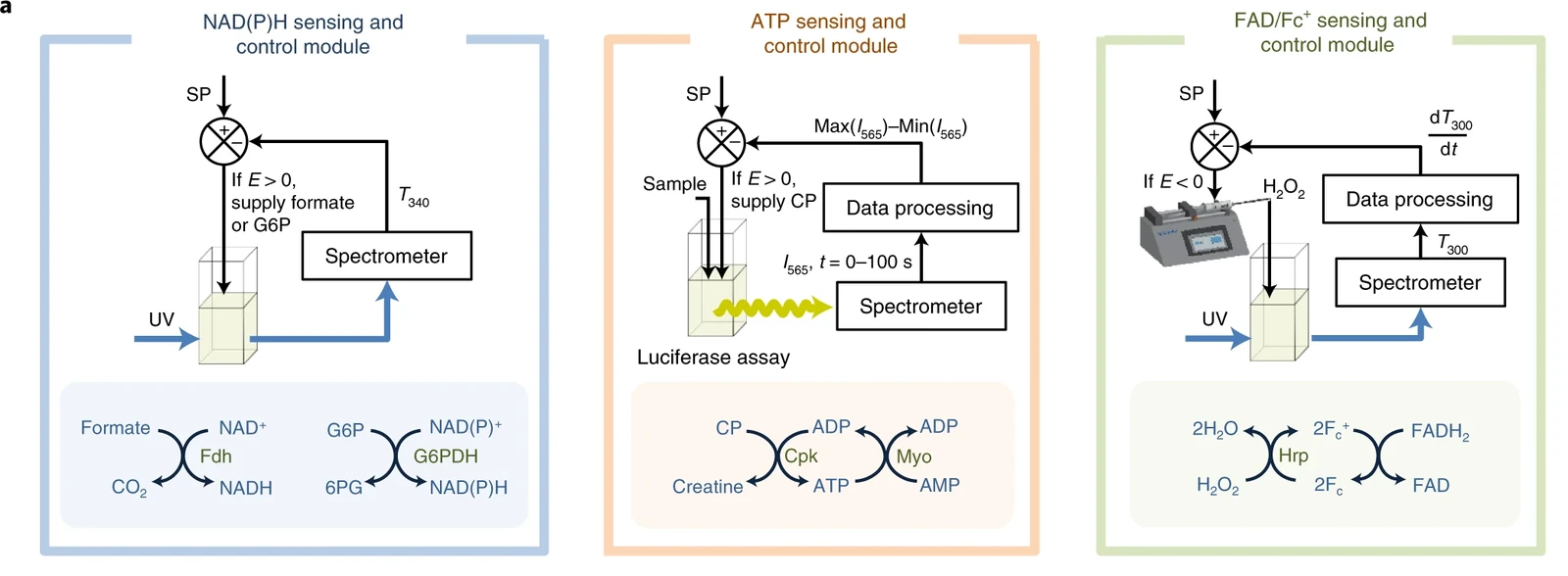
The system is an oxygen-insensitive, self-replenishing cycle that produces acetyl-CoA (C2), pyruvate (C3), and malate (C4) directly from CO₂. Its cofactors (NAD(P)H, ATP, FAD) are held in balance by real-time opto-sensing modules.
Nature already fixes carbon, but its key enzymes come with built-in problems, and the design was really an exercise in routing around them:
- No RuBisCO. The headline enzyme of photosynthesis is slow, and its oxygenase side-reaction wastes energy through photorespiration, which results in one step back for every 3 steps forward. We didn’t use it at all.
- No PFOR or PFL (the second best natural CO2 fixing enzyme) The hardest brain excercise stem from simplifiying the design. Using PFOR or PFL would have massively benefitted the cycle, but it would have introduced enzymes sensitive to oxygen, as they carry iron–sulfur cluster which are highly oxygen-sensitive, which are therefore known as notoriously unstable. A PFOR/PFL-based route would have been elegant and could tighten the cycle - but it was simply too hard to run under ambient conditions. Instead the cycle uses oxygen-insensitive carboxylases (Ppc for the C3→C4 step, Ccr as the oxygen-tolerant stand-in for PFOR).
The elegant part is that the cycle’s products are also its own intermediates. It replenishes its own building blocks as it runs — self-replenishing, and effectively autocatalytic: run it, and it makes more of what it needs to keep running.
The real enemy: instability
Oxygen-insensitive does not imply oxygen-proof. Even with tolerant enzymes we still got aggregation: These proteins aren’t perfectly folded outside their native cell, and they degrade faster for it. The system’s own chemistry attacked them, too: the electron shuttle that we used to regenerate FAD relies on ferrocenium (Fc⁺) and H₂O₂, and both oxidise the enzymes. After six hours, several of the workhorses — PhaA, Ccr, Epi, Ecm, Mcd, Pps, Ppc, Mtk, Mcl — had lost a notable amount of activity and we were able to attribute the damage to Fc⁺ and H₂O₂. Protein oxidation was the culprit. (Free CoA suffers the same fate — oxidised to its disulfide by O₂ and H₂O₂.)
Seeing it happen — control by light
Real-time MS/MS needs equipment we didn’t have — pulling a sample, quenching it, centrifuge-filtering and loading the machine cost 10 minutes on the centrifugation step alone. So we read the cycle optically instead: NAD(P)H by UV absorbance (T₃₄₀), ATP by a luciferase luminescence flash at 565 nm, FAD/Fc⁺ by absorbance at 300 nm. When a signal drifts below setpoint, the controller injects the matching substrate.
The catch is that the signals overlap. NAD(P)H (≈340 nm) and the Fc⁺ shuttle (≈300 nm) sit close together in the UV, and more than one species absorbs in each band. Assigning the right wavelength to the right cofactor — so the readout meant what we thought it meant — was the difference between a controller that stabilised the cycle and one chasing a phantom. It is what turned a reaction we could merely watch into one we could run, for six hours.
The supplies, measurements and analyses
Running the reaction was preconditioned on having the proteins available — and after Paul, Lin and Liang-Yu incepted the protocols, I developed them further, increasing the amount and quality of proteins that we had for the experiments. Roughly half the enzymes I produced and purified by hand (laborious protein manufacture), while the more common ones were ordered in. Beyond that, a lot of my work was in measuring a system where most of the intermediates are invisible:
- Finding the bottleneck. To locate the rate-limiting step, I’d pull samples of the running reaction mixture and spike in an excess of one active enzyme (yes, even more protein drain) — whichever step jumped told us where the cycle was choking. Over a 6-hour run the limiting step kept shifting, as one enzyme after another inactivated.
- ¹³C tracing by MS/MS. Feeding the cycle ¹³C-bicarbonate and ¹³C-formate (converted to ¹³CO₂ in situ) and watching the label march through PEP, glycerate, malate, acetyl-CoA — fully labelled intermediates only appear once the cycle has turned over, which is how we proved it was self-replenishing rather than just leaking product. These experiemtns also required a lot of protein.
The Roads we found Science Locked
- Feeding electrons / “electricity”
- Electron-mediated regeneration — redox-mediator chemistry
- Published route: Fc⁺ + horseradish peroxidase
- Pt-electrode route — tested, dropped (the electrode adsorbed CoA), left as “future work”
- ATP regeneration — two ways that lost
- ATPase
- Polyphosphate kinase (PPK) on cheap polyphosphate
- Published route: creatine phosphate + creatine kinase
- The PFOR/PFL detour
- Chased, then abandoned for the oxygen-insensitive Ccr route